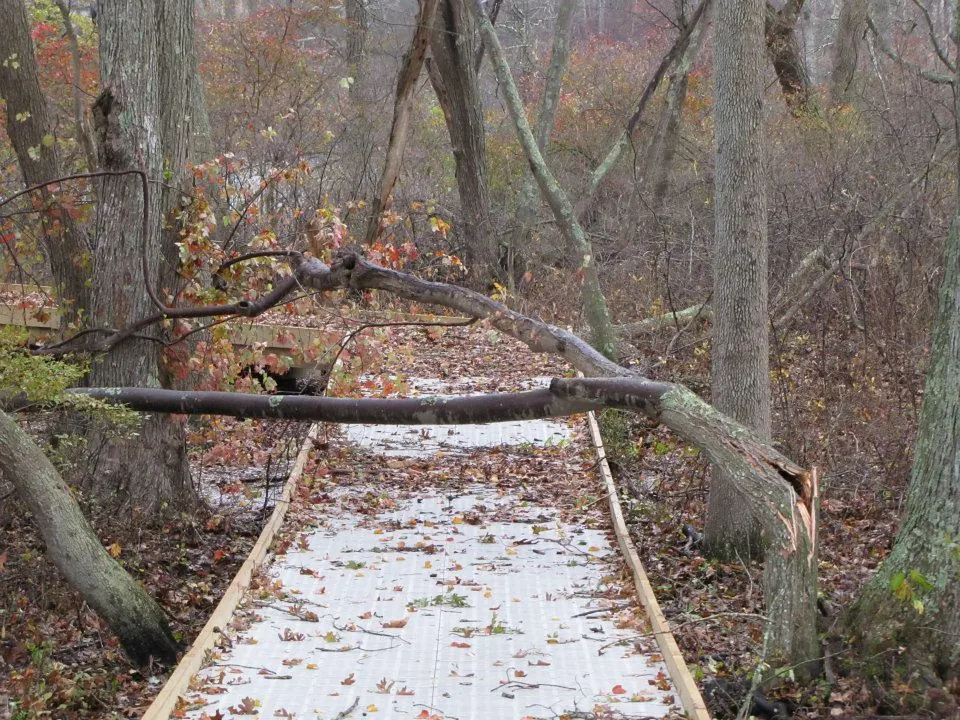
Why trees are Connecticut’s defining claim
About sixty percent of Connecticut is forested, and many older neighborhoods were built under a canopy that is now nearly a century old. Wet snow on leafed-out trees during the October 2011 nor’easter, saturated ground during Sandy, and gusts during Tropical Storm Isaias in 2020 each brought down huge numbers of trees onto roofs, porches, cars and power lines.
What a tree claim really includes
- Removal from the structure. Taking the tree off the house, often by crane, is generally part of the dwelling loss.
- Roof framing. Broken rafters, ridge boards and sheathing beneath intact-looking shingles.
- Load path damage. Cracked ceilings, shifted walls and stuck doors well away from the point of impact.
- Interior water. Rain through the opening before it was tarped.
- Debris removal and stumps. Many policies limit tree debris removal to a small per-tree and per-occurrence amount, and stump grinding is often excluded. These limits are frequently confused with the structure claim.
Tree removal limits in plain terms
Many homeowners forms pay to remove a fallen tree from the property only in specific situations, such as when it damaged a covered structure or blocks a driveway, and only up to a modest sub-limit. The cost to lift the tree off your roof to make repairs is usually treated differently from hauling the trunk away from the yard. Our fallen tree claim calculator walks through how these pieces typically fit together.
Frequently asked questions
Who pays if my neighbor’s tree hits my house?
Usually your own homeowners policy, if the damage is to your property. Your carrier may pursue the neighbor’s insurer if the tree was known to be hazardous.
Is the crane covered?
Removing a tree from the structure so it can be repaired is generally part of the dwelling claim. Crane and rigging costs should be documented and priced.
A tree fell but hit nothing. Is removal covered?
Often not, unless it blocks a driveway or accessibility ramp, depending on the policy. Check the debris removal section of your form.